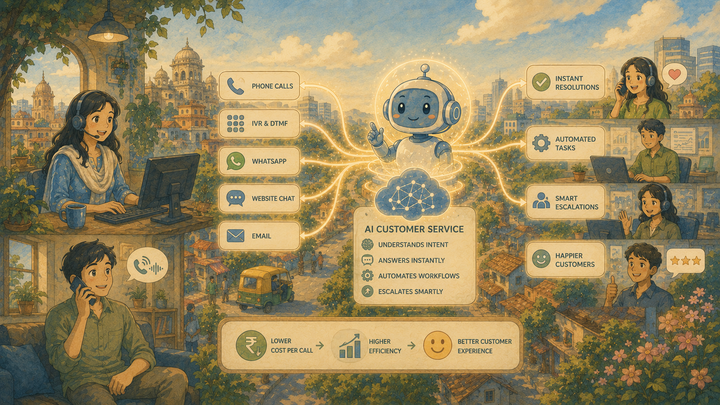
What Is AI Customer Service? How Indian Businesses Automate Support Calls What AI customer service is, how it works, what it can and cannot handle, and what Indian businesses should know about cost, languages, and data security before adopting it.
Conversational AI in Banking: One Customer Memory Across Every Channel Banks, lenders, and insurers spent years adding channels, but not memory, so customers repeat themselves and opportunities slip. Here's how conversational AI in banking carries one customer memory across voice, chat, and email, working across acquisition, servicing, collections, and retention.
The Loop Is the Product Self-learning became the "military-grade encryption" of customer service software: a phrase in every pitch that means less the more it gets used. Here's what a loop that actually improves takes, and why we named a company after it.
Why Regional-Language Conversations Don't Scale Across the Lending Journey (and What AI Employees Change for NBFCs) An NBFC's relationship with a borrower is never a single conversation. It's a lead-qualification call, then onboarding and KYC follow-up, then the first-EMI reminder, then a servicing query, then a renewal nudge, then — sometimes — a collections call. Dozens of touchpoints across one customer&
Best Cloud Telephony Providers in India (2026): The AI Layer on Top This guide covers what cloud telephony is, how to evaluate the best cloud telephony providers in India, and why an AI voice layer on top of your telephony stack is becoming the real differentiator in lead conversion.
Speed-to-Lead: Why the First Lender to Call Wins the Loan This guide explains what speed-to-lead is, why it decides conversions in BFSI, how to generate leads for insurance sales and convert them, and how to build a system that calls every lead in seconds.
Auto Dialer Software vs. AI Voice Agent: Which Converts More Leads for Lenders? This guide gives you the honest comparison: what an auto dialer does well, where it falls short for lead conversion, what an AI voice agent does differently, and a decision framework for choosing between the two.