
IVR Service Providers in India: What an IVR Number Is and How to Choose One (2026)
What an IVR number is, how to get one in India, what to look for in a provider, and how AI voice agents are changing what an IVR can do.
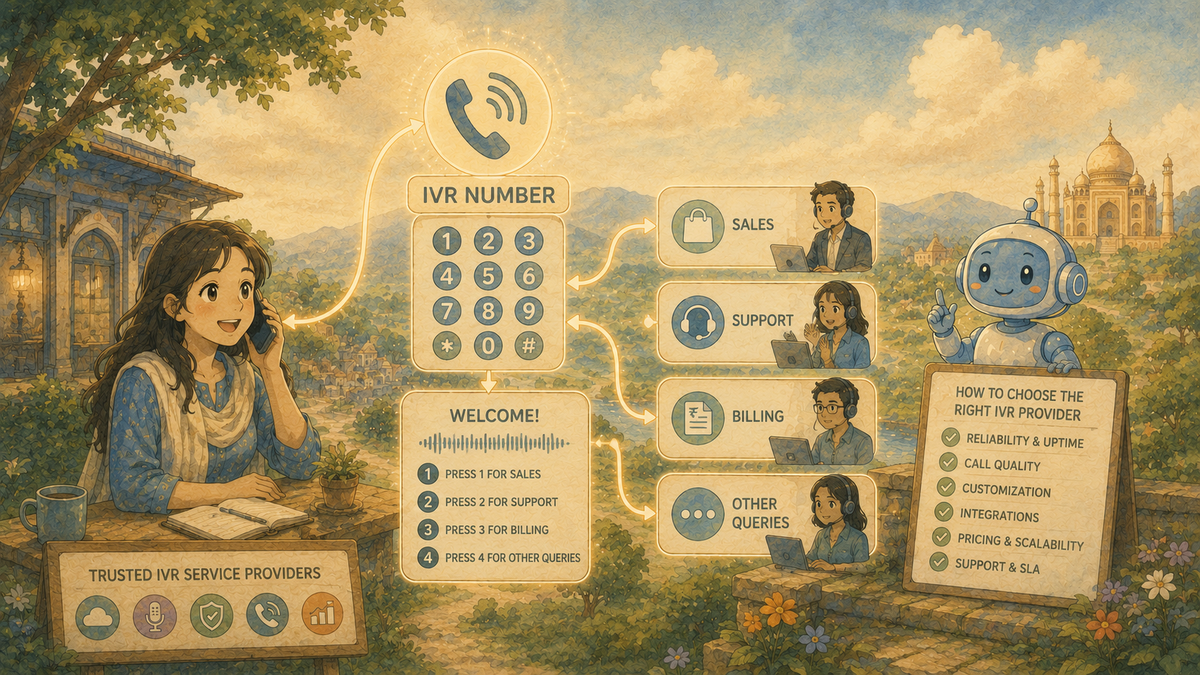
Almost every business in India that takes customer calls runs some form of IVR. It is the automated voice that greets callers and routes them to the right place. Done well, it gets customers to an answer fast. Done badly, it traps them in menu trees they would rather escape.
If you are choosing an IVR service provider, or wondering what an IVR number even is and how to get one, this guide covers it: what an IVR number is, how to get one in India, what to look for in a provider, and how AI voice agents are changing what an IVR can do.
What Is an IVR Number?
An IVR (Interactive Voice Response) number is a business phone number backed by an automated system that greets callers and routes them through voice or keypad menus. When a customer calls, the IVR plays options such as "press 1 for accounts," collects the input, and directs the call to the right team or piece of information. Indian businesses use IVR numbers to manage high inbound call volumes without every call hitting a live agent.
The IVR number itself can be a regular landline-style number, a toll-free number, or a virtual number. What makes it an IVR number is the automated response layer sitting behind it.
How an IVR Number Works
A caller dials the number. The IVR answers, plays a greeting and a menu, and waits for input by voice or keypad. Based on the response, it either gives information directly (such as account balance or office hours), routes the call to the right department, or queues it for an agent. Modern IVR systems connect to a CRM so the routing and the caller's history work together.
How to Get an IVR Number in India
Setting up an IVR number is straightforward with a provider:
1. Choose an IVR service provider based on reliability, features, and integration (see the criteria below).
2. Pick your number type: a virtual number, a standard local number, or a toll-free number.
3. Configure the call flow: greetings, menu options, routing rules, and business hours.
4. Integrate with your CRM and telephony so calls and data stay connected.
5. Test the flows, then go live and monitor call routing and drop-off.
What to Look for in an IVR Service Provider
Reliability and uptime
Call quality and uptime are the foundation. Dropped or poor-quality calls cost you customers directly. Ask for the provider's uptime commitment and how they handle carrier redundancy.
Number types and coverage
Check availability of virtual, local, and toll-free numbers across the regions you serve, and whether you can scale numbers up and down as volume changes.
CRM and software integration
The IVR should connect to your CRM so caller history informs routing and outcomes are logged. Manual reconciliation between systems creates lag and lost context.
Multi-language support
India is multilingual. Your IVR should greet and serve callers in Hindi, English, and the regional languages your customers speak.
Scalability and pricing
Pricing is usually per-number plus usage. Confirm it scales sensibly through seasonal call spikes without manual provisioning or quality drops.
Types of IVR and Related Inbound Services
Inbound IVR
The standard case: greeting and routing inbound customer calls. This is what most businesses mean by an IVR number.
Multi-level IVR
Nested menus for larger operations with many departments. Useful, but deep menu trees frustrate callers, which is exactly where AI voice agents help.
Missed call service
A popular India-specific service: customers give a missed call to a number to trigger a callback, verification, or information flow. A missed call service is a low-cost way to capture intent and is often bundled with IVR.
Beyond Menus: AI Voice Agents vs. Traditional IVR
Traditional IVR routes calls. It cannot hold a conversation. When a caller's need does not fit a menu option, they are stuck pressing zero to reach a human. AI voice agents change this: instead of a menu, the caller simply says what they need, and the AI understands and resolves it.
| Dimension | Traditional IVR | AI Voice Agent |
|---|---|---|
| Interaction | Menu trees, keypad input | Natural conversation |
| Resolves queries | Routes only | Resolves routine queries directly |
| Caller experience | Often frustrating, high drop-off | Conversational, faster to an answer |
| Languages | Pre-recorded per language | Understands and replies across languages |
Platforms like 8loop sit on the same inbound numbers you already use and replace rigid menus with an AI voice agent that actually answers the question. You keep the number and the routing; you upgrade the conversation.
Frequently Asked Questions
What is an IVR number?
An IVR (Interactive Voice Response) number is a business phone number backed by an automated system that greets callers and routes them through voice or keypad menus. When a customer calls, it plays options such as "press 1 for accounts," collects input, and routes the call or provides information. Indian businesses use IVR numbers to manage high inbound call volumes without every call reaching a live agent.
How do I get an IVR number in India?
To get an IVR number in India, choose an IVR service provider, select a number type (virtual, local, or toll-free), and configure your call flow with greetings, menu options, and routing rules. Integrate it with your CRM and telephony so calls and data stay connected, then test the flows and go live. Setup is typically quick; the longer decisions are provider choice and how you design the menus or AI conversation.
What is the best IVR service provider in India?
The best IVR service provider for an Indian business depends on call volume, number-type needs, and integrations. The criteria that matter most are call reliability and uptime, availability of virtual and toll-free numbers, real-time CRM integration, multi-language support for Hindi and regional languages, and pricing that scales with seasonal volume. Businesses focused on customer experience increasingly choose providers that offer AI voice agents on top of traditional IVR routing.
How much does an IVR number cost in India?
IVR pricing in India is typically a monthly fee per number plus usage-based charges (per minute or per call), with costs varying by number type, call volume, and features such as multi-level menus, recording, and integrations. Toll-free numbers cost more than virtual numbers. The more useful figure is total cost against outcomes: how much agent time the IVR saves, and whether adding an AI voice agent resolves more calls without extra headcount.
What is the difference between IVR and an AI voice agent?
A traditional IVR routes calls through fixed menus and keypad input; it directs callers but cannot resolve a query itself. An AI voice agent holds a natural conversation: the caller says what they need, and the AI understands and resolves routine issues directly, escalating complex cases to a human. IVR is a routing layer; an AI voice agent is a resolution layer that can sit on the same inbound number and replace the menu experience.
What is a missed call service?
A missed call service is an India-specific inbound service where a customer gives a missed call to a business number to trigger an action: a callback, a verification, a lead capture, or an information flow. The customer is not charged because the call is not answered. Businesses use it as a low-cost way to capture intent and respond, and it is often bundled with IVR and other inbound calling services.
See How 8loop Upgrades Your IVR
8loop replaces frustrating menu trees with an AI voice agent that answers your inbound support calls in natural conversation, across Hindi and regional languages. It works with your existing numbers and routing, resolves routine queries directly, and escalates the rest to your team, with no rip-and-replace.
Book a demo to see 8loop on your inbound line