Make Your Cold Calling Funnel Work (with AI and the Human Touch)

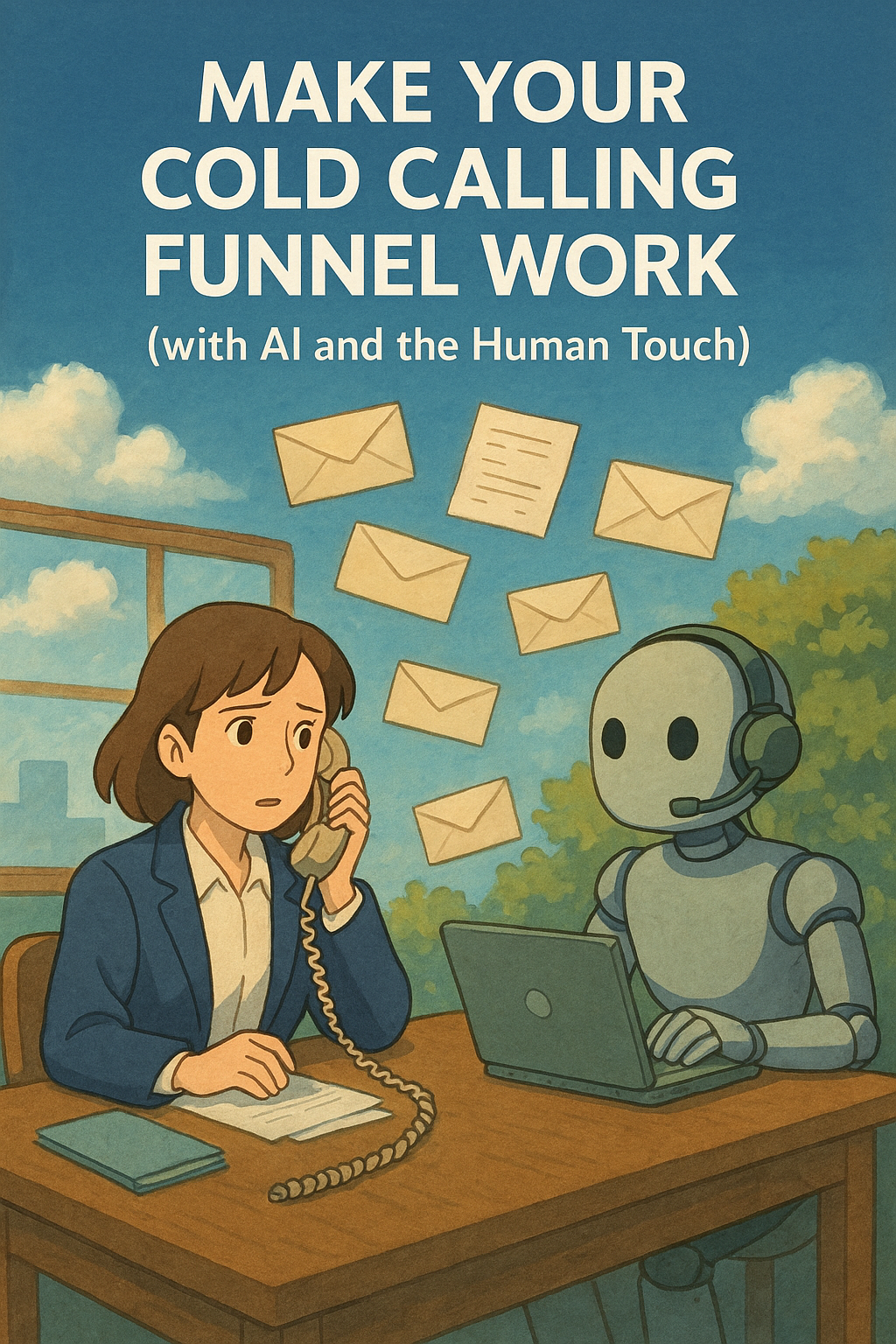
Your best rep, Sarah, just quit.
She lasted a few months - same as the last three hires. You're now scrambling to backfill while your pipeline bleeds.
Meanwhile, your team lead is burning out training people who'll be gone by quarter-end. Your CFO wants to know why you're spending $40K a month on callers while conversion rates stay flat.
You add more headcount. Tweak the script again. Switch dialers. And nothing moves.
If all this sounds familiar, the problem isn't with your team. It's the system that you have built around them.
Why traditional outbound stops scaling
What happens as your outbound teams grow:
Your best rep converts at 8%. Your worst? Maybe 2%. You can't clone the good ones, and you can't fire your way to consistency.
Then the cracks show:
You hire three people in your regional office. Two quit within 90 days because the rejection rate destroys morale. According to recent research, SDR turnover rates consistently average above 30% - with 12% of companies seeing annual rates exceeding 55%. Bandalier
You want to expand into Spanish-speaking markets, but finding bilingual hires takes months - by the time you're staffed, the opportunity's moved.
Your training process is now a full-time job. You're teaching the same opener for the hundredth time while deals slip through the cracks. The typical SDR takes 3.1 months to reach full productivity, and with average tenure at just 1.8 years, you only get about 17 months of fully productive work before starting over. Blossomstreetventures
Connect rates hold steady, but conversion rates stay flat. More dials ≠ more revenue.
Your CAC is climbing and your board is asking uncomfortable questions. A ProfitWell analysis of nearly 1,800 B2B and B2C subscription companies found that customer acquisition costs are nearly 70% higher for B2B companies than they were six years ago. Clyde
That's not a training problem. It's a structural one.
Most outbound funnels were never designed to scale - they were designed to survive. And there's finally a way to fix it without doubling your headcount.
Let AI take your first calls - and let humans do what they do best
Let's get things straight: AI isn't replacing your sales team.
If you think it is, you'll build something your customers hate and your reps will sabotage.
Here's what AI actually does: it handles the brutal first 30 seconds so your team can focus on conversations that might actually go somewhere.
The shift:
Instead of burning energy on dead ends, AI opens the conversation in your prospect's language, checks basic interest, and then hands off.
Your callers spend time with people who actually picked up the phone wanting to continue the conversation.
Step 1: Map your funnel before you automate anything
This is where most teams screw up.
They bolt AI onto a broken process and wonder why it doesn't work. AI doesn't fix your funnel - it exposes what's already broken, just faster.
A typical call journey: Dial → Greeting → Interest check → Qualification → Booking
Find your cliffs - the exact moment most people bail.
Sit with your team for an hour. You'll hear:
"People hang up the second I say the company name."
"I lose them when I ask about their current provider."
"The first 30 seconds are just... brutal."
That's where AI goes.
If most prospects drop during the opener, that's not a people problem - it's a script problem. Fix that first, then automate.
If they hang up during qualification, your criteria are probably too vague. Tighten them before you hand anything to AI.
Map the pain. Then automate the pain.
Step 2: Redesign where humans and AI meet
Once you know where people drop off, it's obvious where humans shine - and where they burn out.
In most outbound setups, the first 30 seconds eat up 80% of the emotional labor. That's the zone for AI to shine.
It looks like this in practice:
- AI opens the call in your prospect's local language
- It checks basic eligibility (existing contract? interested in switching?)
- It only transfers qualified, interested prospects to your team
The handoff has to feel natural. Both sides need to know what's happening.
To the prospect: "Great! I'm connecting you with my colleague Marcus who can walk you through your options."
To your rep (via screen pop): "Lisa Chen, 34, current customer with CompetitorX. Interested in lower rates. Prefers English. Connecting now."
That's context your rep can use - not start over from scratch.
What we learned the hard way
When we first tested this with a fintech client, prospects kept hanging up during the transfer.
Turns out, a 4-second silence is an eternity on a cold call. People assume they've been dumped into a call center queue.
We fixed it by having the AI say the rep's name immediately: "Connecting you with Marcus now."
Transfers jumped 40% overnight.
This small change had a massive impact on the hand-off rates.
Step 3: Measure what actually improves
Don't just track bookings. Track the whole funnel.
Here's what matters:
1. Dialed Numbers Total attempts per day. With AI, this number scales without adding headcount.
2. Connect Rate How many calls reach a human. Industry data shows the average connection rate hovers around 16.6%. REsimpli If this stays steady but outcomes improve, you're working smarter, not just harder.
3. Hand-off Rate Percentage of calls warm enough for AI to transfer. Based on our work with multiple customers throughout 2024 and 2025, most teams start around 10-20%. We've seen clients hit 35% when the AI script mirrors what their best rep actually says - not some corporate-approved version.
4. Conversion Rate (Post-Handoff) Of the calls your reps take, how many close? This should increase because they're only talking to qualified prospects. The average cold calling conversion rate is around 2-5%, but this can jump significantly higher when you're only connecting with pre-qualified, interested prospects. TrellusCloudTalk
5. Drop-offs During Transfer Calls lost in the handoff. Red flag: usually means lag, bad context transfer, or tone mismatch between AI and human. Fix this first. It's the fastest ROI win.
6. Drop-offs Before Transfer Prospects who hang up while still talking to AI. Indicates script problems or language/accent issues.
7. Drop-offs After Transfer Prospects who bail once they reach your rep. Usually means your rep didn't get enough context - or got wrong context.
8. Customer Acquisition Cost (CAC) The ultimate metric. If CAC drops while conversions hold or rise, your AI layer is working.
What actually happens when this works
In early 2025, we worked with a digital lending platform in the consumer lending space (loan sizes: $5K-$100K) that predominantly depended on outbound and was burning through reps every quarter.
Before AI:
- 12 reps making 2,400 calls/day
- 8% connect rate
- 2-3% conversion rate
- CAC: $180
After adding AI to handle first contact:
- Same 12 reps, now handling 3× more qualified conversations
- AI making 10,000+ first-contact calls/day
- Hand-off rate: 28%
- Conversion rate (post-handoff): 12%
- CAC: $95
What changed for the team:
Reps stopped dreading Monday mornings. Sarah (yes, that Sarah) came back after three months. She told us: "I'm actually selling now instead of getting hung up on."
Morale matters. Retention matters. AI didn't make the team redundant. It made them effective.
The part nobody tells you
Here's the thing about AI in outbound: it doesn't fix a broken funnel. It just exposes it faster.
Based on what we've seen working with customers, if your script is weak, AI will fail at scale. If your handoff is clunky, you'll lose warm leads faster than before. If your reps aren't trained to handle qualified conversations, you've just built an expensive filtering system that goes nowhere.
AI amplifies what you built. If your process is broken, it breaks faster.
So before you add AI to cold calling, make sure you know what you're actually trying to scale. Because efficiency without strategy is just expensive noise.
FAQ: What People Actually Ask Us
"Won't AI sound robotic and turn people off?"
Only if you build it that way. The AI needs to sound like your best rep on their best day - not a TTS robot. Accent, pacing, natural pauses matter. If it sounds like a call center bot from 2015, yes, people will hang up.
"What if a prospect asks the AI something complex?"
That's the point of the handoff. AI isn't trying to close deals - it's filtering interest. If someone asks about pricing details, the AI says: "That's a great question - let me connect you with my colleague who can walk you through the exact numbers."
"How long does it take to train the AI on our script?"
A few hours if you have a clean script and clear qualification criteria. Longer if you don't. Most of the time isn't technical - it's getting your team to agree on what "qualified" actually means.
"What if my team feels threatened?"
They will, at first. Especially your senior reps who think they don't need help.
Show them the numbers: they'll handle 3× more interested prospects while spending zero time on dead-end calls. Frame it as a promotion, not a replacement. Because that's what it is.
Building this yourself vs. working with a vendor
Most teams choose one of two paths when implementing AI in their cold calling funnel:
Build it yourself: Requires a technical team, 2-3 months of iteration, and ongoing maintenance. Best if you have unique workflows or need deep customization.
Work with a vendor: Faster deployment (2-4 weeks), pre-built integrations, and support. Better if you need speed-to-market or lack in-house AI expertise.
At 8loop(Eightloop), we focus on the second path. We map your process, identify exactly where prospects drop off, and deploy AI agents that sound like your best reps - not generic bots.
Whether you build or buy, the framework stays the same: map your funnel, isolate where humans add unique value, and automate the rest.
Want to discuss your specific setup? Get in touch with us at contact-us@8loop.ai