AI and Sales: How AI Sells, Scores, and Closes in 2026 A practical look at how AI handles prospecting, lead scoring, calling, and closing in 2026 — with a focus on what actually works for regulated selling like lending and collections.
AI Receptionist: What It Is, How It Works, and How to Choose One (2026) An AI receptionist answers, routes, and books calls 24/7 in a natural voice — no hold music, no missed calls, no extra staff. Here is how it works and how to choose one.
AI Answering Service: The 2026 Guide (and How to Choose One) An AI answering service uses a conversational voice agent to answer your inbound calls around the clock, at a fraction of the cost of human operators. Here's how it works and what to look for.
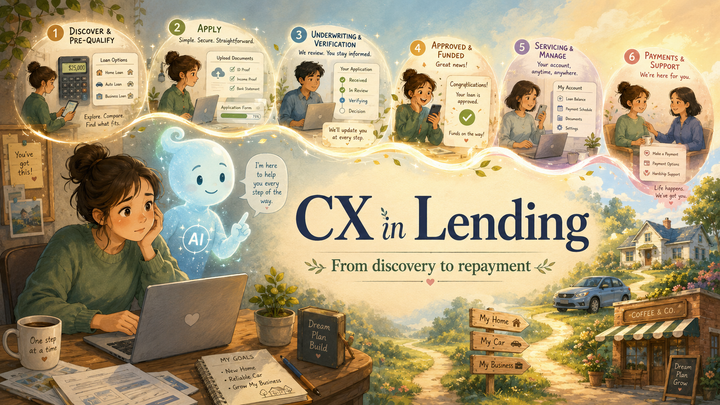
CX in Lending: The Complete Map of Use Cases and Workflows A complete map of customer experience use cases and workflows across the lending lifecycle, from pre-application to collections and retention, and what you can actually do about each.
The End of the Efficiency vs. Experience Tradeoff: Why Customer Support Is About to Change Forever For decades, businesses have been quietly making a compromise they hoped their customers would never notice. When the phone became the primary support channel, companies hired agents, built call centers, and created entire operational machines around managing them. Then email arrived, and businesses had to build a separate machine. Then
Story behind the Brandmark Infinity represents potential without limits, an idea that resonated deeply with us. We founded this company with the belief that businesses shouldn’t be constrained by traditional boundaries. With the right intelligence, growth can be exponential, and innovation can be infinite. That led us to the symbol ∞ — infinity. When rotated
How to Optimize High-Volume Cold Outbound with AI (30-Day Experiment Results) Outbound can be broadly classified into two types: cold outreach and warm outreach. This post focuses on cold outbound and how AI is reshaping it. What is Cold Outreach? Cold outreach is when your buyer doesn’t know you, yet you still follow a predictable formula: * Reach out to X