
What Is an AI Calling Agent? How Indian Lenders Automate Outbound Calls
An AI calling agent places and handles phone calls automatically. Here is how Indian NBFCs and banks use it to automate outbound calls across the lending lifecycle.
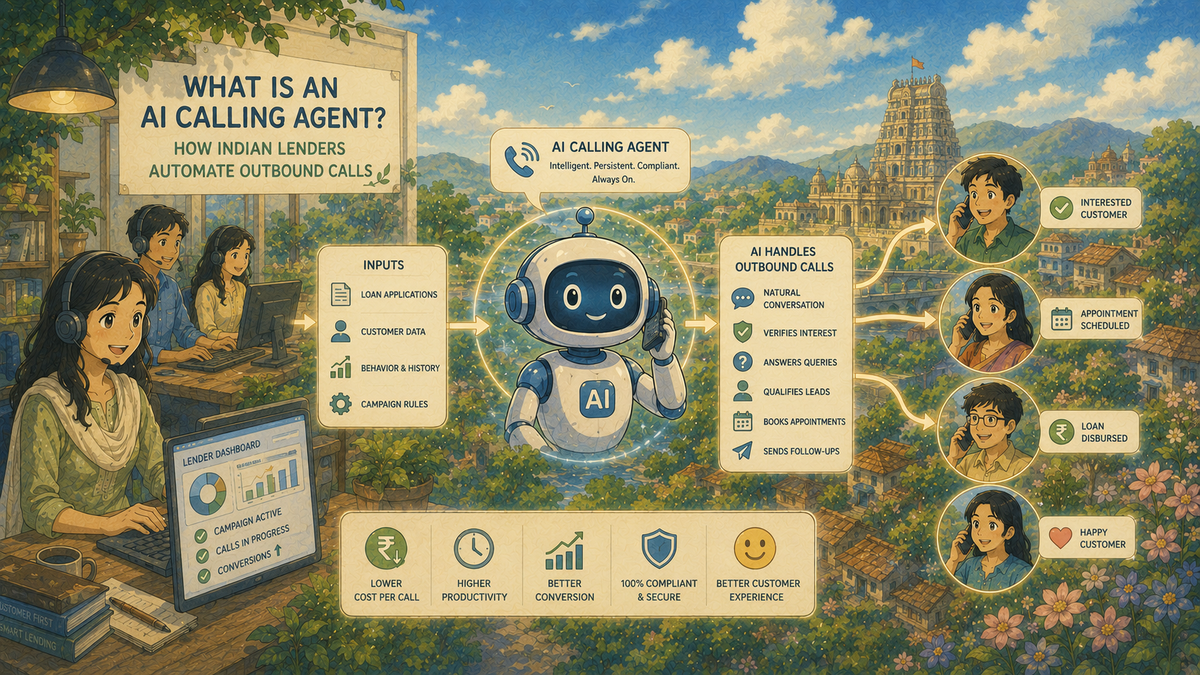
A borrower fills out a loan application on your website at 9pm. By the time a tele-caller reaches them the next afternoon, they have already taken a top-up from another NBFC. Speed lost that deal, not price.
This is the gap an AI calling agent closes. It calls the moment a lead arrives, at 9pm or 6am, in Hindi or Tamil, without a single new hire on your floor.
Indian lenders run on phone contact. Loan qualification, verification, EMI reminders, and collections all happen over voice, at a volume no calling team can staff for during festival-season spikes. This guide explains what an AI calling agent is, how it fits the lending lifecycle, what TRAI rules apply to outbound calling, and how it compares to your current auto-dialer and tele-caller setup.
What Is an AI Calling Agent?
An AI calling agent is software that uses conversational AI to place and handle phone calls automatically, speaking with customers in natural language instead of playing recordings. For Indian lenders, it dials borrowers, qualifies leads, confirms EMI dates, and answers loan queries in Hindi and regional languages, then logs every outcome to your CRM.
Think of it as an always-on member of your calling team that never takes a break, never forgets the script, and handles thousands of conversations at once. It listens, understands intent, responds, and takes an action such as booking a callback or flagging a hot lead.
This is a different category from the auto-dialers and IVR menus most lenders already run. An auto-dialer speeds up how fast a human gets connected. An AI calling agent removes the need for a human to be on the line at all for routine, high-volume conversations.
How an AI Calling Agent Works
An AI calling agent sits between your telephony and your CRM. It listens for a trigger, makes the call, holds the conversation, and writes the result back. Here is the flow for a typical lending use case.
It triggers on a signal, not a fixed schedule
The agent fires when something happens: a lead fills a form, an EMI falls due, or a KYC document is pending. Because it acts on the signal instead of a next-day call list, it reaches high-intent borrowers while they are still deciding. Speed-to-lead is often the difference between funding the loan and losing it to a faster lender.
It speaks in the borrower's language
Most Indian borrowers are more comfortable in a regional language than in English. An AI calling agent switches between Hindi, Tamil, Telugu, Kannada, and other languages mid-conversation, matching how your best tele-callers already work. This is what separates modern AI outbound calling from the robotic recorded messages borrowers hang up on.
It updates your telephony and CRM automatically
Every call is transcribed, scored, and logged. Disposition codes, callback requests, and lead scores flow straight into your CRM without manual data entry. Because the AI calling agent connects to your existing cloud telephony provider, there is no rip-and-replace of the stack your team already knows.
Why Indian Lenders Are Adopting AI Calling Agents Now
The shift is not about novelty. It is about three constraints that human-only calling teams cannot solve.
Speed-to-lead decides who funds the loan
When a borrower drops their number, the first lender to reach them usually wins. Human teams cannot call every fresh lead within seconds, especially after hours. An AI calling agent can, which is why speed-to-lead in Indian BFSI has become a board-level metric rather than an operations detail.
Volume spikes without a hiring cycle
Festival season, salary-day collections, and new product launches create call volume that a fixed headcount cannot absorb. Hiring, training, and later releasing tele-callers is slow and expensive. An AI calling agent scales the same day, then scales back down, so you handle demand capture without over-staffing for the peak.
Consistent conversations and full auditability
Human quality varies by caller, by shift, and by mood. An AI voice agent runs the same approved conversation every time, and produces a transcript for every call. For a regulated lender, that audit trail matters as much as the conversion lift.
AI Calling Agent vs Human Tele-caller vs Auto-dialer
Most lenders already run auto-dialers and human teams. Here is how the three approaches compare on the levers that matter for a high-volume calling floor.
| Factor | AI calling agent | Human tele-caller | Auto-dialer |
|---|---|---|---|
| Talks to the customer | Yes, autonomously | Yes | No, only connects the call |
| Scales with volume | Instantly, thousands in parallel | Limited by headcount | Limited by available agents |
| Cost per interaction | Low and fixed | High, rises with hiring | Medium, still needs staff |
| Regional-language coverage | Multiple languages built in | Depends on who you hire | Not applicable |
The point is not that AI replaces your callers. It is that AI handles the repetitive, high-volume contact so your people focus on complex negotiations and closing. In INR terms, the cost per connected call drops sharply once an AI calling agent absorbs the routine volume, which is what makes the economics work at scale. For a deeper build-versus-buy view, see our guide to AI call center software for lending.
Where an AI Calling Agent Fits the Lending Lifecycle
An AI calling agent is not a single feature bolted onto one team. It runs across the borrower journey, from the first inbound lead to recovery. 8loop deploys AI voice agents for lending tuned to each of these stages, because a collections conversation is nothing like a fresh-lead pitch.
Lead qualification and demand capture
The agent calls new applicants within seconds, confirms intent, checks basic eligibility, and books qualified prospects for a human closer. Used this way, an AI voice agent for sales lifts contact rates on fresh leads without adding a single seat, and keeps your closers focused on borrowers who are ready to sign.
Verification and onboarding
Post-approval, the agent chases pending KYC documents, confirms details, and walks borrowers through next steps. These calls are repetitive and rule-bound, which is exactly where automation pays off and where AI cold calling anxiety does not apply, because the borrower already applied.
EMI reminders and early collections
Pre-due and early-bucket reminders are high volume and time sensitive. An AI calling agent reaches every borrower before the EMI date, offers payment options, and escalates only the accounts that need a human. This is where most lenders see the fastest return, and where AI outbound calling replaces the most manual work.
TRAI Rules for AI Outbound Calling in India
Outbound calling in India is governed by the Telecom Regulatory Authority of India (TRAI), primarily through the Telecom Commercial Communications Customer Preference Regulations, 2018 (TCCCPR 2018). These rules apply to an AI calling agent the same way they apply to a human tele-caller.
The practical distinction is between the calls you make. Contact with a customer who applied for your loan or holds an active account is generally treated as transactional or service communication, which sits on safer footing. Cold promotional calls to people who have not consented, and especially to numbers on the Do Not Disturb (DND) registry, face tighter restrictions. If you use an AI calling agent for demand capture, honour the same consent, DND, and calling-hour rules a human caller must follow.
Conduct during recovery calls also falls under the Reserve Bank of India (RBI) Fair Practices Code, which governs how borrowers may be contacted. You can read the regulations directly from the regulators at TRAI and the Reserve Bank of India.
This is general information on the regulatory landscape, not legal advice. Confirm your specific obligations with your compliance team.
Frequently Asked Questions
What is an AI calling agent?
An AI calling agent is software that makes and answers phone calls on its own, holding a natural spoken conversation instead of playing a recorded script. Indian lenders use it to qualify loan leads, confirm applications, remind borrowers about EMI due dates, and answer queries in Hindi and regional languages. Every call is transcribed and logged to your CRM, so the agent works as an always-on extension of your calling team.
What is the difference between an AI calling agent and an auto-dialer?
An auto-dialer only dials numbers and connects them to a human tele-caller, so you still need staff to talk. An AI calling agent dials and holds the conversation itself, answering questions and capturing responses without a human on the line. Auto-dialers speed up dialing but not talk-time. AI calling software removes the staffing ceiling entirely, which is why lenders facing volume spikes move from one to the other.
Are AI calling agents allowed for outbound calls in India?
Outbound calling in India is governed by TRAI's Telecom Commercial Communications Customer Preference Regulations, 2018. Calls to customers who applied for your loan or hold an active account are generally treated as transactional or service contact. Cold promotional calls to people on the Do Not Disturb registry face tighter restrictions. An AI calling agent must honour the same consent and DND rules a human caller does. Confirm your obligations with your compliance team.
How much can an AI calling agent save an NBFC?
Savings depend on call volume, but the economics are straightforward. A human tele-caller in India handles a limited number of connected calls per shift, while an AI calling agent runs thousands of parallel conversations at a fixed cost per interaction. Lenders typically see the biggest gains in EMI reminders and early collections, where volume is high and each conversation is short. The result is lower cost per contact and higher contact rates during peak cycles.
What is the best AI calling agent for lenders in India?
The best AI calling agent for a lender depends on language coverage, telephony and CRM integration, and depth of deployment support. Look for regional-language handling, an agnostic connector to your existing telephony, and a team that configures the agent for lending workflows rather than handing you raw software. 8loop is one option built for high-volume BFSI use cases in India, deploying AI voice agents for lending across sales, verification, and collections.
How long does it take to deploy an AI calling agent?
Deployment time depends on how many use cases you automate and how clean your data is. A single workflow, such as EMI reminders, can go live faster than a full sales-and-collections rollout. Most of the work is configuration: connecting your telephony and CRM, tuning the conversation for your products, and testing in your borrowers' languages. Providers with a dedicated deployment team, like 8loop, shorten this from months to weeks.
See an AI Calling Agent Built for Lending
If your calling floor cannot keep up with lead volume, EMI reminders, and collections without another hiring cycle, an AI calling agent closes the gap. 8loop builds AI employees for CX that plug into your existing telephony and CRM, speak your borrowers' languages, and deliver measurable conversion and cost outcomes.
Start with the full picture in our hub guide to outbound call center services for lending, or compare approaches in auto-dialer vs AI voice agent. When you are ready to see it live, book a demo with 8loop.

