
SMS Debt Collection: Where It Works, and Where Voice Wins
SMS is the cheapest way to nudge early-stage EMI accounts, but it cannot recover the buckets that stop responding. Where SMS debt collection works, where it stalls, and how AI voice wins the harder DPD buckets for NBFCs.
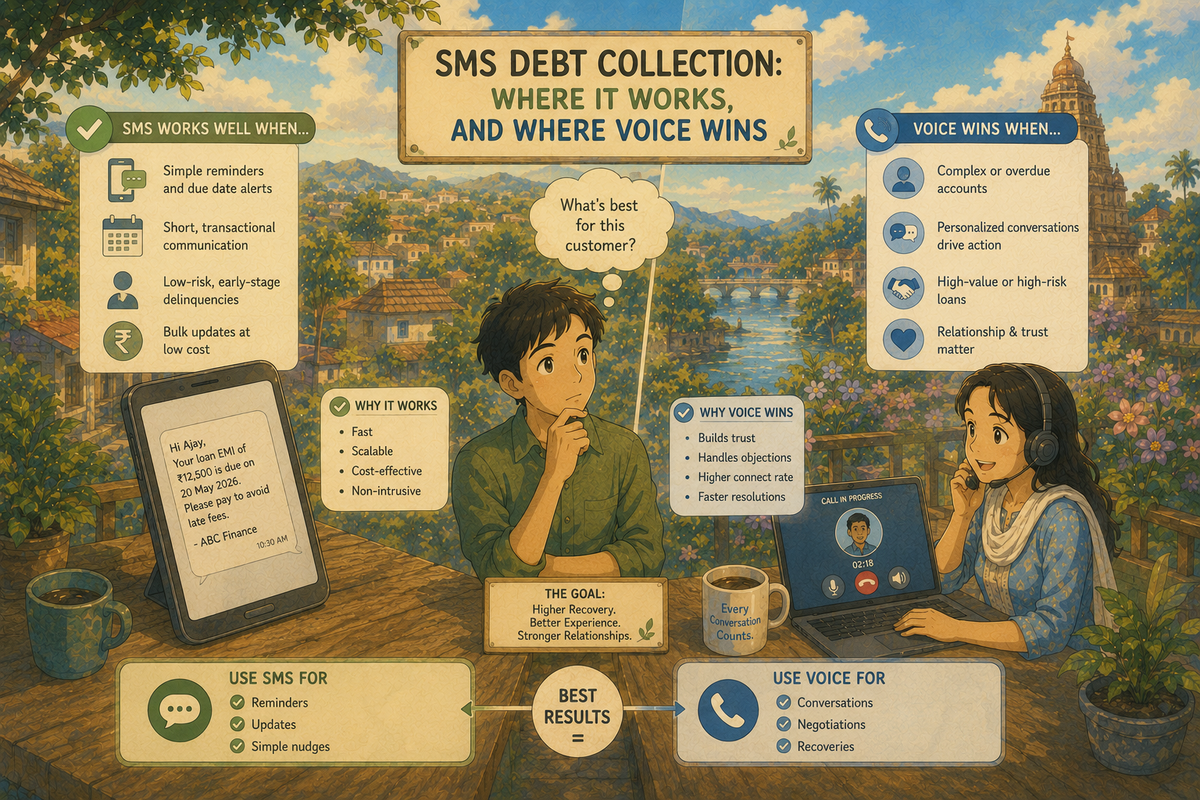
A borrower misses an EMI. Your team fires off a payment reminder by text, and for a good share of accounts the money lands that same day. For the rest, nothing moves. That gap is the whole story of SMS debt collection.
SMS is the cheapest, most scalable nudge a lender has. It is also the bluntest tool in the recovery kit. A text cannot ask why the payment is late, it cannot negotiate a new date, and it cannot bring back accounts that have already gone quiet.
This guide covers what SMS debt collection is, where it works and where it stalls, and how to sequence it with WhatsApp and AI voice across your DPD buckets so you recover more without adding headcount.
What Is SMS Debt Collection?
SMS debt collection is the use of automated text messages to remind borrowers about due or overdue payments, share payment links, and prompt repayment. Lenders and NBFCs use it as a low-cost, high-volume channel for early-stage EMI reminders, sent through DLT-registered templates under India's telecom rules.
In practice, an NBFC schedules messages tied to the repayment calendar: a pre-due reminder a few days before the EMI date, a due-date message on the day itself, and an overdue nudge if the payment is missed. Each carries the outstanding amount in INR, the due date, and a payment link.
The appeal is obvious. One person can trigger debt collection reminders to a hundred thousand borrowers in minutes, at a cost measured in fractions of a rupee per message. For borrowers who simply forgot, that nudge is often all it takes. This is why almost every lending book in India runs some form of automated collection messages at the top of the funnel.
Where SMS Debt Collection Works
SMS earns its place at the early end of the collections journey, where the job is a reminder rather than a resolution.
It is cheap and scales without headcount
No channel touches SMS on unit economics. You can cover an entire portfolio for the price of a few field visits, and the send does not slow down when volumes spike at month-end. For a growing loan book, your collections cost per account stays flat while the book grows.
It is non-intrusive for early-stage nudges
A text respects the borrower's time. It arrives quietly, it can be read later, and it does not demand an answer in the moment. For a customer who is one or two days past due and fully intends to pay, a polite payment reminder is the right amount of pressure. Anything heavier this early risks the relationship.
It carries the payment link
A single tap takes a borrower from the reminder to a UPI or netbanking screen. When intent already exists, removing friction is most of the battle, and well-built automated collection messages close the loop between the nudge and repayment in seconds.
Where SMS Debt Collection Falls Short
The same qualities that make SMS a good reminder make it a poor recovery tool once an account slips deeper into the buckets.
No two-way resolution
A text is a broadcast, not a conversation. It cannot ask why the borrower has not paid, cannot handle "I lost my job, can I pay half next week," and cannot log a promise-to-pay. The moment recovery needs a negotiation, a one-way channel runs out of road.
Weak late-stage recovery
Response to SMS drops sharply as accounts age. A borrower ignoring texts at 15 DPD will not be moved by a fourth identical message at 75 DPD. By the time an account nears the 90-day NPA line, the accounts that self-cure on a text already have. The rest need a human-quality conversation, and SMS cannot supply one.
DLT and consent constraints
SMS runs inside India's DLT framework under TRAI rules. Every template has to be pre-registered, promotional content is filtered against DND preferences, and message length and formatting are constrained. That keeps the channel disciplined, but it also limits how far you can adapt the message to an individual borrower's situation.
The Channel Ladder: SMS to WhatsApp to AI Voice
Think of your channels as a ladder that matches effort and cost to how hard an account is to recover. The right question is never "SMS or voice." It is "which channel fits this DPD bucket."
Pre-due to 30 DPD: lead with SMS
Most of the book is here, and most of it self-cures. Automated payment reminders by SMS carry these buckets at the lowest possible cost. Reserve richer channels for the accounts that ignore the nudge.
15 to 60 DPD: layer in WhatsApp
WhatsApp adds read receipts, richer formatting, and a limited reply path. It suits borrowers who need more than a one-line text but are not yet a hard case, a natural middle rung between a broadcast and a call.
30 DPD to pre-NPA: escalate to AI voice
Once an account stops responding to text, the job changes from reminding to resolving. That needs a conversation, which is where AI voice agents come in. It is the same logic behind moving to digital debt collection orchestrated across channels rather than a single blast.
Comparing the three channels
| Factor | SMS | AI voice | |
|---|---|---|---|
| Cost per contact | Lowest (fractions of a rupee) | Low | Higher, still far below a human agent |
| Two-way resolution | None (one-way) | Limited (templated replies, links) | Full (real conversation, negotiation, PTP) |
| Best DPD bucket | Pre-due to 30 DPD | 15 to 60 DPD | 30 DPD to 90+ (pre-NPA) |
| Compliance footing | DLT templates, TRAI consent | Platform policy plus consent | RBI FPC calling hours plus consent |
Why AI Voice Converts the Harder Buckets
The accounts SMS cannot recover are not a lost cause. They are a conversation problem. A borrower at 60 DPD usually has a reason and a rough plan, and recovery hinges on someone surfacing both and agreeing a date.
That is what a one-way channel cannot do and what human callers do well but expensively. Hiring, training, and retaining a large calling team is slow, and the cost climbs with the book. AI voice agents close that gap by holding a natural, two-way conversation at scale: they ask why the payment is late, handle the common objections, capture a promise-to-pay, and route genuine hardship cases to a human.
8loop builds AI voice agents for NBFC collections that work the buckets SMS leaves behind. They call the moment an account crosses a threshold, speak the borrower's language, and log every outcome so your team sees which accounts are curing and which need escalation. It is augmentation, not a replacement, so your recovery team spends its time on the cases that actually need a person. For a fuller view, see our guide to AI for loan recovery.
A Practical Channel Mix for NBFCs
You do not have to choose one channel. You sequence them. A recovery stack that outperforms a single-channel approach looks like this.
- Pre-due to 30 DPD: SMS payment reminders as the default, with a WhatsApp nudge for non-responders.
- 30 to 60 DPD: AI voice on the accounts that ignored text and WhatsApp, to open a real conversation and capture promises-to-pay.
- 60 to 90 DPD: AI voice as the primary channel, with humans handling escalations, disputes, and hardship cases.
- 90+ DPD (NPA): human agents and field teams, briefed with the full contact history the earlier channels captured.
The point is not that voice beats SMS. Each channel earns a different bucket, and the recovery you are missing usually sits in the buckets SMS was never built to close. For a broader platform comparison, see our guide to the best debt collection software in India.
RBI, TRAI, and DLT: The Rules Around Collections Messaging
Two regulators shape how you can contact borrowers in India. Understanding both keeps your recovery program on safe footing.
The Reserve Bank of India sets conduct standards through the Fair Practices Code for NBFCs. It covers how recovery is carried out, including guidance that borrowers should not be contacted outside reasonable hours (commonly read as before 8am or after 7pm) and should not be subjected to harassment. These conduct rules apply across every channel, SMS, WhatsApp, and voice alike.
The Telecom Regulatory Authority of India governs the messaging channels themselves through the TCCCPR framework. Commercial SMS runs on DLT-registered headers and templates, and the rules distinguish service or transactional messages tied to an existing relationship from promotional messages, which are filtered against DND preferences. Consent and the message type determine what you can send and when.
This is general information on the regulatory landscape, not legal advice. Confirm your specific obligations with your compliance team.
Frequently Asked Questions
What is SMS debt collection?
SMS debt collection is the use of automated text messages to remind borrowers about due or overdue payments, share payment links, and prompt repayment. Lenders and NBFCs use it as a cheap, high-volume channel for early-stage EMI reminders. It works well for borrowers who simply forgot, but it cannot hold a conversation, so recovery weakens as accounts age past 30 to 60 days.
Is SMS or AI voice better for debt collection?
Neither is universally better; they fit different DPD buckets. SMS is the cheapest way to nudge early-stage accounts (pre-due to 30 DPD) where most borrowers self-cure. AI voice wins the harder, later buckets because it holds a real two-way conversation, negotiates a date, and captures a promise-to-pay. The strongest NBFC recovery stacks use SMS first and escalate non-responders to voice.
Is SMS debt collection allowed under RBI and TRAI rules in India?
Contacting your own borrowers about their loans is common practice, but it sits inside two rulebooks. RBI's Fair Practices Code governs recovery conduct, including reasonable contact hours and no harassment. TRAI's TCCCPR framework governs the SMS channel through DLT-registered templates and consent, separating service messages from promotional ones. This is general information on the regulatory landscape, not legal advice. Confirm your specific obligations with your compliance team.
How effective is SMS for late-stage collections?
SMS effectiveness falls sharply as accounts age. In early buckets it recovers a meaningful share of accounts because those borrowers only needed a reminder. By 60 to 90 DPD, the accounts that respond to text have already cured, and repeated messages rarely move the rest. Late-stage recovery depends on a two-way conversation to understand the reason for non-payment, which SMS cannot provide and AI voice can.
What is the best SMS debt collection or payment reminder software in India?
The best fit depends on which buckets you are solving. For high-volume, early-stage SMS and payment reminders, look for platforms with DLT template management, scheduling tied to the repayment calendar, and payment-link integration. For the late-stage buckets SMS cannot recover, 8loop provides AI voice agents built for NBFC collections that hold two-way conversations and negotiate repayment. Many lenders run a reminder tool for SMS and add voice for escalations.
How should an NBFC combine SMS, WhatsApp, and voice?
Match the channel to the DPD bucket. Lead with SMS payment reminders from pre-due to 30 DPD, layer in WhatsApp for non-responders who need a little more, and escalate to AI voice from about 30 DPD onward where recovery needs a real conversation. Reserve human agents and field teams for 90+ DPD cases, briefed with the contact history the earlier channels captured. Sequence, do not silo.
Recover the Buckets SMS Cannot Reach
SMS will always own the top of your collections funnel. The recovery you are leaving on the table sits lower down, in the accounts that stopped answering texts and now need a conversation. That is exactly the work 8loop's AI voice agents were built for.
See how 8loop works the harder buckets for NBFCs and lenders. Book a demo.


