
AI for Loan Recovery: How Voice AI Is Changing Collections
How AI voice agents run loan recovery for Indian NBFCs: EMI reminders, payment-plan negotiation, promise-to-pay capture, and RBI-aligned conduct across the DPD lifecycle.
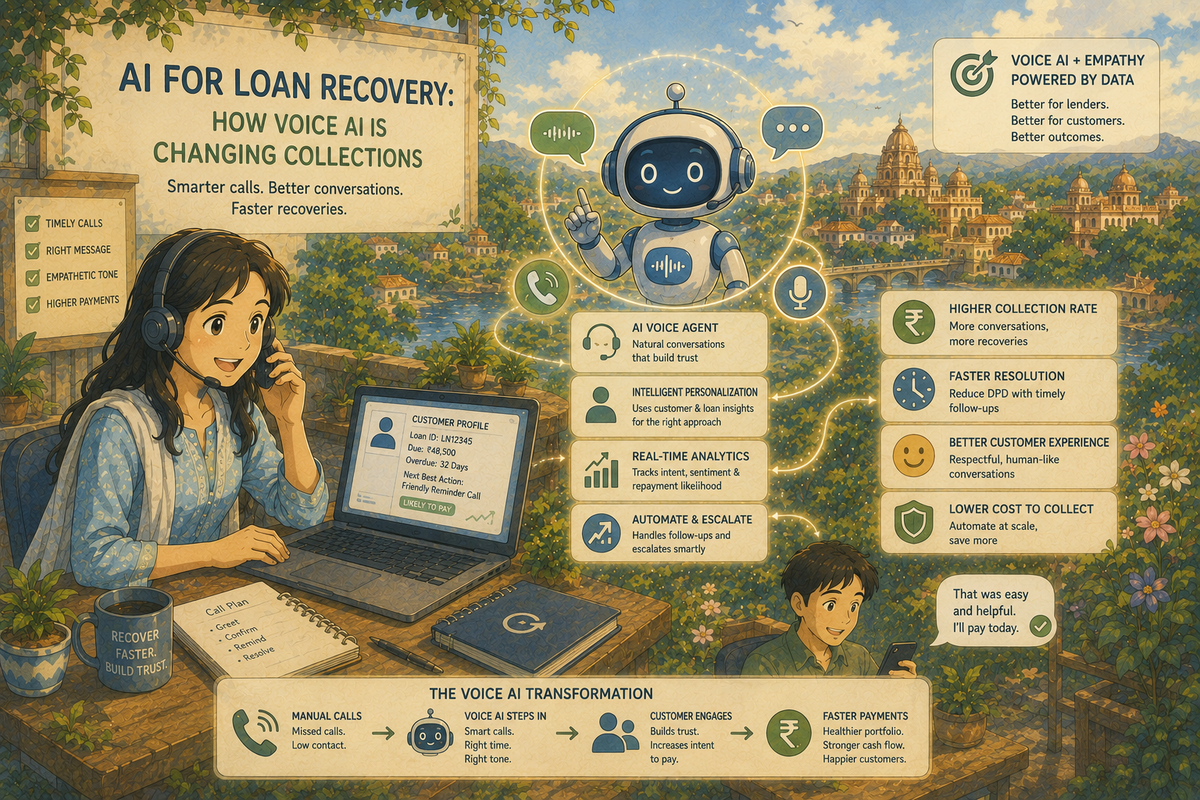
It is the last week of the month at a mid-sized NBFC. Thousands of EMIs have slipped past their due date, the collections floor is dialing as fast as it can, and the buckets that matter most, the early-DPD borrowers who will pay if someone reaches them in time, are the ones going untouched.
Recovery has always been a capacity problem. You can only recover as fast as you can hire, train, and retain callers, and every one of those callers has to follow the RBI Fair Practices Code on every single call. Add regional languages, seasonal spikes, and attrition, and the maths stops working.
AI for loan recovery changes that maths. This guide explains what AI for loan recovery is, how AI voice agents run recovery calls across the DPD lifecycle, how they stay borrower-friendly and aligned to India's regulatory framework, and how lenders are thinking about the economics. It is part of the wider move to modern debt collection software in India.
What Is AI for Loan Recovery?
AI for loan recovery is the use of AI voice agents to contact borrowers and run collections conversations automatically, handling everything from pre-due EMI reminders through payment-plan negotiation and promise-to-pay capture, so an NBFC or lender can scale recovery outreach across the full DPD lifecycle without adding callers.
In practice, an AI voice agent places or answers calls, speaks in a natural, human-like voice, and holds a real conversation with the borrower. It knows the loan, the outstanding EMI, and the due date, and it follows a script that keeps the tone respectful and the conduct within your policy.
AI for loan recovery is a lending-specific application of AI debt collection, tuned to the way NBFCs and banks actually run their buckets. The same agent can send a gentle pre-due nudge to one borrower and negotiate a structured payment plan with another, then capture a promise-to-pay and log it for the next touchpoint.
How AI Voice Agents Run Recovery Calls
A recovery call is not one script. An AI collection agent runs a sequence of tasks that mirror what a good human caller does, only at far greater volume. This is what people mean by agentic AI for collections: an AI that does not just play a recorded message but takes the next action, negotiating, capturing a commitment, and escalating when it needs to. Tools built for voice AI for collections, such as 8loop, are designed to handle the full conversation. You can see how this maps to lending in our guide to AI voice agents for NBFC collections.
EMI reminders and pre-due nudges
Before an EMI is even late, the agent can call the borrower with a simple reminder of the amount and date. These pre-due touches are cheap, high in volume, and often the single biggest lever on early recovery, because many borrowers simply forget or misremember the date.
Negotiating payment plans
When a borrower cannot pay in full, the agent offers the options you allow, such as a partial payment, a revised date, or a short instalment arrangement. It stays inside the guardrails you set, so it never promises a settlement or waiver it is not authorized to give.
Capturing promise-to-pay
Every commitment the borrower makes is captured as a structured promise-to-pay, with the amount and date recorded against the account. That turns a vague "I will pay soon" into a trackable commitment your system can follow up on automatically.
Escalation to human agents
Some conversations need a person: a dispute, genuine hardship, a legal query, or a borrower in real distress. The agent recognizes these and routes them to a human recovery officer with the context already attached, so nothing starts from zero.
AI for Loan Recovery Across the DPD Lifecycle
Recovery is a game of buckets, and the right conversation depends on how many days past due (DPD) an account is. AI for loan recovery is part of the wider shift to digital debt collection, and its advantage is running the right message for each bucket without adding staff.
Pre-due and early DPD (0 to 30 days)
This is where volume is highest and outcomes are cheapest to influence. Automated reminders and gentle early-DPD nudges catch the borrowers who intend to pay, which frees your team to focus on the harder cases further down the book.
Mid DPD (31 to 90 days)
Here the conversation shifts to negotiation. The agent works through payment-plan options and captures promise-to-pay commitments, keeping consistent pressure across a large book that a human team could never cover in full.
Late buckets (90 DPD and beyond)
As accounts approach NPA classification, cases get complex and human judgment matters more. AI still helps by handling routine follow-ups and keeping records clean, while your specialists focus on the accounts that need them.
Multilingual Recovery in Regional Languages
India does not collect in one language. Borrowers in Chennai, Indore, and Guwahati expect different languages, and recovery conversations land better in the borrower's own tongue.
An AI voice agent can run the same borrower-friendly recovery flow in Hindi, Tamil, Telugu, Kannada, and more, switching by borrower profile without a separate team for each language. That reach is hard to staff manually, and it is one of the clearest advantages of AI for loan recovery in a market as linguistically diverse as India.
RBI-Aligned, Borrower-Friendly Recovery Conduct
Recovery in India sits inside a clear regulatory framework, and automation does not change the rules. It should make them easier to follow.
The RBI Fair Practices Code sets expectations for how lenders and their recovery agents treat borrowers, including reasonable calling hours, respectful conduct, and no harassment. The calling channel itself sits under TRAI's Telecom Commercial Communications Customer Preference Regulations (TCCCPR), which govern commercial voice and message traffic.
An AI collection agent can be configured to respect these boundaries on every call: calling within permitted hours, keeping a consistent respectful tone, avoiding repeated harassing contact, and logging every interaction for audit. Because the conduct is set in configuration rather than left to individual mood or memory, it is easier to keep consistent and to review.
You can read the Fair Practices Code guidance on the Reserve Bank of India site and the TCCCPR framework via TRAI.
This is general information on the regulatory landscape, not legal advice. Confirm your specific obligations with your compliance team.
Human Recovery Agents vs AI Voice Agents
This is about seeing where each does its best work, not about replacing your team.
| Dimension | Human recovery agents | AI voice agents |
|---|---|---|
| Scale | Capped by hiring, training, and attrition; output dips at month-end peaks | Scales on demand; absorbs volume spikes without new hires |
| Consistency | Varies by agent, mood, and fatigue; scripts drift over a shift | Same approved script and tone on every call |
| Compliance | Depends on training and monitoring; hard to audit across a large floor | Configured to RBI-aligned rules; every call logged and reviewable |
| Cost | Per-seat cost rises with every unit of volume | Lower cost per attempt; economics improve as volume grows |
The Economics of AI-Led Recovery
For a lender, the case for AI for loan recovery is about the economics of reach, not any single call. Human recovery capacity is capped by how many callers you can hire and keep. An AI loan recovery agent removes that cap, so you can attempt more borrowers, reach early-DPD accounts sooner, and cover the buckets a stretched team never gets to.
The direction is clear even before you measure it. Cost per attempt falls when a call no longer needs a human seat, and contact rates rise when outreach is not limited by team size or working hours. Follow-up also gets more consistent, because every promise-to-pay is captured and logged rather than left to memory.
This is augmentation, not replacement. Your recovery team moves off repetitive early-bucket dialing and onto the harder, higher-value cases that need human judgment. 8loop deploys as the AI voice agent for those routine recovery conversations, working inside your existing telephony and CRM so the team keeps its current tools. For a broader view of the category, see our guide to loan recovery software for NBFCs.
It is still early days for hard benchmarks in Indian lending, so treat specific recovery-rate claims with caution and run your own pilot before committing to numbers.
Frequently Asked Questions
What is AI for loan recovery?
AI for loan recovery is the use of AI voice agents to run collections calls automatically for lenders, covering EMI reminders, payment-plan negotiation, and promise-to-pay capture. Instead of a human dialing each borrower, an AI collection agent handles routine conversations at scale across every DPD bucket, logs the outcome, and escalates complex cases to a person. It lets NBFCs expand recovery outreach without expanding the calling team.
What is voice AI for collections and how does it work?
Voice AI for collections is software that places or receives recovery calls using a natural, human-like AI voice agent. The agent identifies the borrower, states the amount and due date, answers questions, negotiates a payment plan within the rules you set, and captures a promise-to-pay. It works in the borrower's preferred language, follows an approved script on every call, and passes edge cases to a human agent when needed.
Is AI debt collection legal in India?
AI debt collection operates within the same rules as human recovery. India's RBI Fair Practices Code governs recovery conduct, such as calling hours and borrower treatment, while the TRAI TCCCPR framework governs commercial calling channels. An AI collection agent can be configured to follow these rules on every call. This is general information on the regulatory landscape, not legal advice. Confirm your specific obligations with your compliance team.
Does AI for loan recovery improve recovery rates?
AI for loan recovery mainly changes the economics of outreach. Because an AI voice agent can attempt far more calls than a human team at a lower cost per attempt, lenders can reach early-DPD borrowers sooner and cover buckets that usually go untouched. Directionally, that means higher contact rates and more consistent follow-up. Actual results vary by portfolio, borrower mix, and how your recovery workflows are configured.
What is the best AI for loan recovery or voice AI for collections in India?
The best AI for loan recovery in India depends on your telephony stack, languages, and DPD workflows. Look for a voice AI built for Indian lending: regional-language coverage, configurable RBI-aligned scripts, CRM and dialer integration, and clear outcome reporting. 8loop is one option, an AI voice agent purpose-built for NBFC and lender collections that deploys with your existing systems. Evaluate two or three vendors against your own recovery process before deciding.
How do NBFCs deploy an AI loan recovery agent?
NBFCs usually start with one recovery use case, such as pre-due or early-DPD reminders, on a defined borrower segment. The AI loan recovery agent connects to your existing cloud telephony and CRM, so there is no rip-and-replace. Scripts are configured for your products, languages, and RBI-aligned conduct, then tested on a small batch before scaling. Outcomes feed back into reporting, so you can expand to more buckets with confidence.
See 8loop in Action
8loop is an AI voice agent built for high-volume recovery at NBFCs and lenders. It runs EMI reminders, payment-plan conversations, and promise-to-pay capture across the DPD lifecycle, in your borrowers' languages, inside the telephony and CRM you already use.
See how AI for loan recovery would work on your own portfolio. Book a demo with 8loop.

