
Automating Customer Onboarding Calls for Lenders
How NBFCs and lenders in India automate welcome, KYC, document, and first-EMI onboarding calls with AI voice agents, and how to measure activation, time-to-first-EMI, and early drop-off.
What Is Customer Onboarding Software for Lenders?
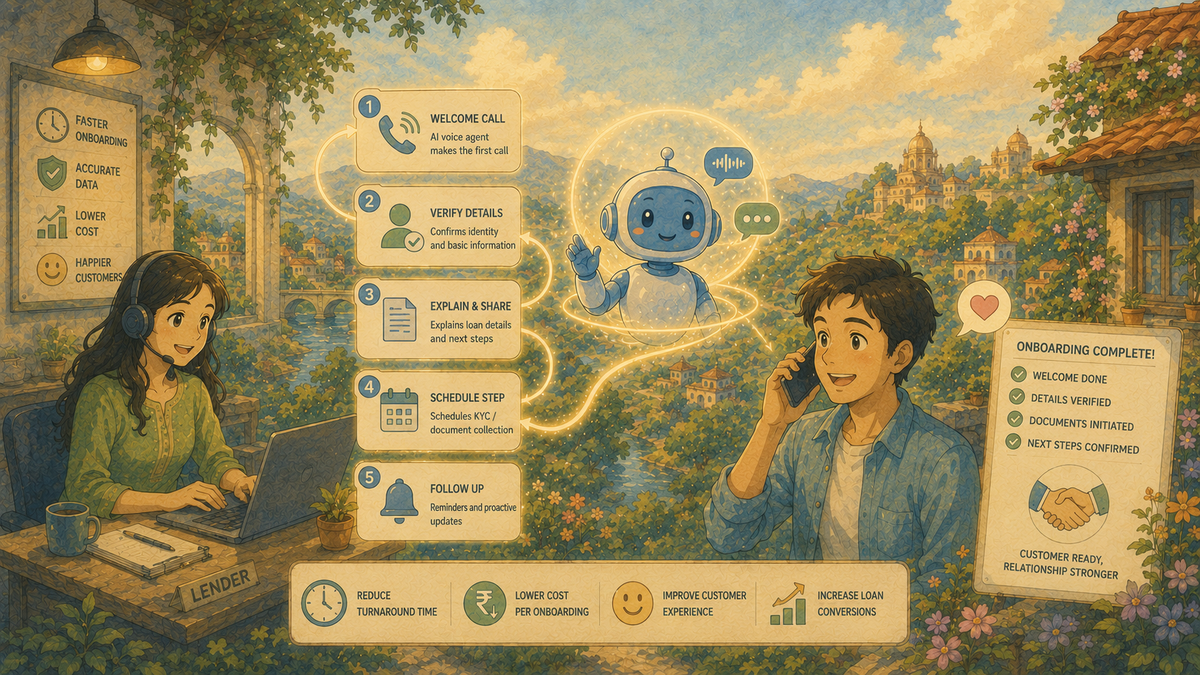
Customer onboarding software for lenders automates the calls and follow-ups a new borrower needs after loan approval: KYC verification, document collection, first-EMI setup, and product activation. For NBFCs running high volumes, AI voice agents handle these onboarding calls at scale, so every new customer reaches first repayment without waiting on a manual caller.
In lending, onboarding is not a welcome email. It is a sequence of phone conversations that decide whether a sanctioned loan actually turns into an active, repaying account. A borrower who signed the agreement still has to finish KYC, submit a pending document, set up an e-mandate, and understand when the first EMI is due. Miss any of those and the account stalls.
Most Indian lenders run this stage with a manual calling team. That works until volume climbs. When 500 new borrowers arrive in a week, a team of ten cannot reach all of them fast enough, and the ones who slip through become early defaults or drop-offs. Onboarding software fixes the coverage problem by putting an AI voice agent on every new account from day one.
Why Onboarding Calls Decide the Loan Relationship
The first 30 days after disbursal set the tone for the entire loan. A borrower who is contacted quickly, gets their questions answered, and completes setup on the first call tends to pay on time. A borrower who is left waiting forms a very different impression of the lender.
Onboarding calls carry real business weight. They confirm the loan terms, close out any pending KYC, collect documents the credit team still needs, and walk the customer through mandate setup so the first EMI does not fail. Done well, they lift activation and cut early delinquency. Done poorly, they leak revenue quietly.
This is also where speed matters. The same logic behind speed-to-lead in BFSI applies after the loan closes: the faster you reach a new borrower, the more likely they complete every step while intent is still high.
Where Onboarding Calls Break Down
Manual onboarding fails in predictable ways once a lender scales. The problems are rarely about the borrower being unwilling. They are about the process not reaching people in time.
Calls are slow and inconsistent
A manual team calls in batches, in the order that fits their shift. A borrower who disbursed on Friday evening might not hear from anyone until Monday afternoon. By then, some have forgotten the details, and a few have already changed their mind about the product.
Documents and KYC get dropped
Pending KYC and document collection are the most common reasons an account sits in limbo. When one caller handles hundreds of files, follow-ups slip. The account cannot be activated, and the credit team is left chasing paperwork weeks later.
First-EMI setup gets missed
Most first-EMI misses come from a setup gap, not from unwillingness to pay. If the borrower never completed the e-mandate or misread the due date, the payment simply fails. A manual team that never got around to the setup call carries the blame for a "default" that was really an onboarding miss.
The New-Borrower Onboarding Call Journey
A strong customer onboarding process in lending is a defined sequence, not an ad-hoc call whenever someone has time. These are the stages an AI voice agent can run for every new account.
Stage 1: Welcome and loan confirmation
The first call confirms the loan is live, restates the sanctioned amount and tenure, and sets expectations for what comes next. This is also the moment to confirm the borrower's preferred language so every later call lands in Hindi, Tamil, Telugu, or whichever regional language they are comfortable with.
Stage 2: KYC follow-up and document collection
The agent checks what KYC is still pending, reminds the borrower which document is missing, and explains exactly how to submit it. Clearing this early is what lets the credit team activate the account instead of parking it.
Stage 3: First-EMI and e-mandate setup
The agent walks the borrower through mandate registration, confirms the EMI amount and due date, and answers questions about the repayment schedule. Getting this right on the onboarding call is the single biggest lever on first-EMI success.
Stage 4: Product activation and feature walkthrough
For products with an app or portal, the agent guides the borrower through activation: logging in, viewing the schedule, and knowing where to pay. An activated customer is far less likely to call support later in confusion.
Stage 5: Early engagement and drop-off prevention
A short check-in a few days in catches confusion before it becomes a missed payment or a complaint. This early-engagement call is where an attentive lender separates itself from one that goes quiet after disbursal.
How AI Voice Agents Automate Onboarding Calls
AI voice agents place and handle onboarding calls the way a trained caller would, but for every new account and without a queue. If you are new to the concept, start with what an AI calling agent is and how it holds a real conversation.
The agent connects to your existing cloud telephony and loan management system, so there is no rip-and-replace. When a loan disburses, it triggers the welcome call within minutes, works through KYC and mandate setup across follow-ups, and logs the outcome of every conversation. Borrowers who need a human are routed to your team, so the agent handles volume while people handle exceptions.
This is where 8loop fits. It deploys AI voice agents tuned for the specific onboarding steps a lender runs, in the borrower's own language, and reports on what each call achieved. It sits inside the same motion as your outbound call center for lending, so onboarding, reminders, and collections run as one connected system rather than three disconnected teams.
Manual vs AI-Automated Onboarding Calls
The gap between a manual onboarding team and automated onboarding calls widens as volume grows.
| Dimension | Manual onboarding team | AI-automated onboarding calls |
|---|---|---|
| Speed to first contact | Hours to days, batched by shift | Minutes after disbursal, every account |
| Consistency | Varies by caller and mood | Same script and steps every time |
| Cost per call | Rises with every new hire | Flat as volume scales |
| Language coverage | Limited to the callers you hired | Multiple regional languages on demand |
How to Measure Onboarding Call Performance
Automating onboarding is only worth it if you can see the result. Three metrics tell you whether your onboarding calls are working.
Activation rate
The share of disbursed loans that complete every onboarding step and become fully active accounts. This is the headline number. If activation climbs after you automate, the calls are doing their job of clearing KYC, documents, and setup.
Time-to-first-EMI
How long it takes a new borrower to reach their first successful EMI. Faster is better, and it usually improves once every account gets a prompt mandate-setup call instead of waiting in a manual queue.
Early drop-off
The percentage of new borrowers who stall, miss the first payment, or go silent in the first 30 days. Consistent onboarding calls tend to pull this number down because setup gaps get caught early. Track it per product and per language to see where the process still leaks.
RBI KYC, Fair Practices, and TRAI: What to Know
Onboarding calls in lending touch two regulatory areas. The conduct of verification and borrower interaction sits under the RBI KYC Master Direction and the Fair Practices Code for NBFCs. The calling channel itself is governed by TRAI rules on commercial communication.
Transactional, consented calls to a customer who has already taken a loan sit on safer footing than cold promotional outreach. Service-related onboarding contact is treated differently from marketing. Keeping calls tied to the borrower's active loan, and keeping records of consent and outcomes, matters for both frameworks.
This is general information on the regulatory landscape, not legal advice. Confirm your specific obligations with your compliance team.
Frequently Asked Questions
What is customer onboarding software for lenders?
Customer onboarding software for lenders automates the post-approval steps a new borrower must complete: KYC verification, document collection, e-mandate setup for the first EMI, and product activation. Instead of relying on a manual calling team, NBFCs use AI voice agents to reach every new customer within minutes, in their preferred language, and guide them to first repayment. It turns a scattered manual handoff into a measurable, repeatable process.
What is included in a lending customer onboarding call?
A lending customer onboarding call typically covers five stages: a welcome and loan confirmation, KYC follow-up and pending document collection, first-EMI and e-mandate setup, product or account activation, and an early check-in to catch confusion before it becomes drop-off. Each stage moves the borrower closer to activation and on-time repayment. Automating these calls means no new customer waits days for a human caller to reach them.
Are automated onboarding calls allowed under RBI and TRAI rules?
Automated onboarding calls sit on safer footing when they are transactional and tied to a loan the customer has already taken, rather than cold promotional outreach. RBI KYC rules and the Fair Practices Code govern verification and borrower conduct, while TRAI regulates the calling channel itself. Consented, service-related calls are treated differently from marketing calls. This is general information on the regulatory landscape, not legal advice. Confirm your specific obligations with your compliance team.
Do automated onboarding calls improve first-EMI collection?
Yes, because most first-EMI misses come from setup gaps, not unwillingness to pay. When a borrower never completed the e-mandate or misunderstood the due date, the first payment fails. Automating onboarding calls means every new customer is reminded to set up the mandate, confirms the EMI amount and date, and gets questions answered early. Lenders measure the impact through activation rate, time-to-first-EMI, and early drop-off, which usually improve once calls are consistent.
What is the best customer onboarding software for lenders and NBFCs in India?
The best customer onboarding software for lenders in India depends on call volume, language coverage, and how well it integrates with your existing telephony and loan management system. 8loop is one option built for high-volume Indian lenders, deploying AI voice agents that handle onboarding calls in regional languages and report on activation and first-EMI outcomes. Evaluate any vendor on language support, integration depth, and whether it delivers measurable outcomes rather than just call minutes.
How long does it take to deploy AI voice agents for onboarding calls?
Deployment usually takes a few weeks, not months, because AI voice agents connect to your existing cloud telephony and CRM rather than replacing them. The main work is configuring the onboarding call flow for your products, languages, and KYC steps, then testing on a sample of new borrowers. With 8loop, a solution engineering team handles this setup and tuning, so your onboarding calls go live and start showing activation data quickly.
See Automated Onboarding Calls in Action
If new borrowers are slipping between disbursal and first EMI, the fix is coverage: reaching every account fast, in the right language, with the same steps every time. That is what 8loop's AI voice agents do for high-volume lenders. Book a demo to see how automated onboarding calls lift activation and cut early drop-off across your loan book.


